
Folded blanket arrangement
Blanket is folded and compressed into a lining block. Fold direction, installed compression and the joint pattern are coordinated with the wall, roof or door layout.

01Layered lining systems
Traditional folded and sewn ceramic fiber modules with configurable grade, density, compression, dimensions and anchor systems for furnace walls, roofs, doors and lining repairs.
02Overview
Ceramic fiber modules create compressed, joint-controlled linings for furnace walls, roofs and doors. Common supply formats use a 300 × 300 mm face with 150–300 mm thickness; grade, density, compression and anchoring are matched to the lining design.
03Product views
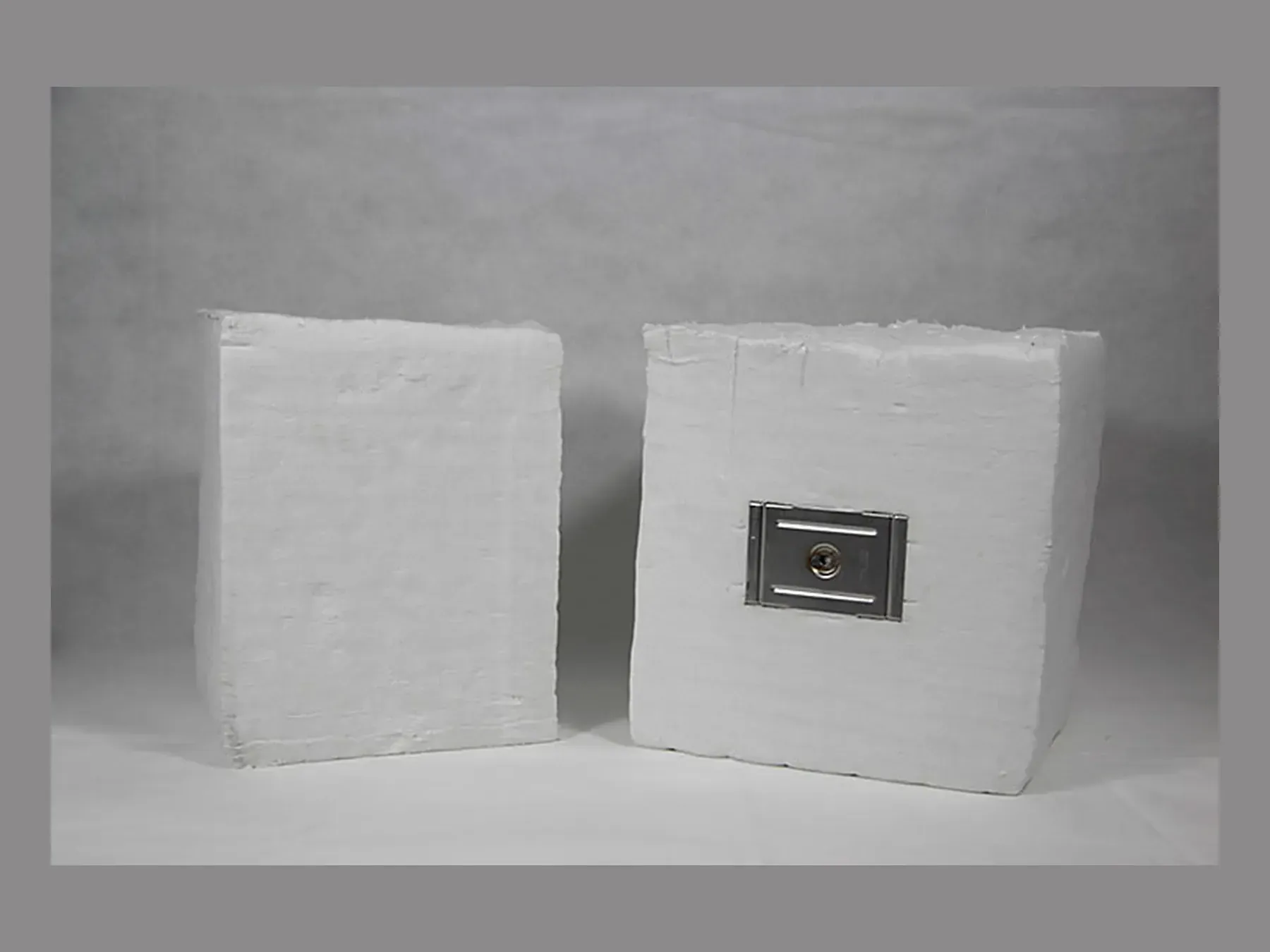


Sewn modules are folded blanket assemblies held in compression by stitching, with anchors selected for the furnace wall, roof or door. The HN-1260 and HN-1430 designations below identify two established sewn constructions, not a universal density or temperature rating for every module. Blanket grade, compression, anchor layout and installed lining thickness are selected for the furnace conditions.
| Property | HN-1260 sewn module | HN-1430 sewn module |
|---|---|---|
| Al₂O₃ content | 42–44% | 34–36% |
| SiO₂ content | 56% | 49% |
| ZrO₂ content | — | 14–17% |
| Working temperature | 1100°C | 1300°C |
| Density | 160–210 kg/m³ | 160–210 kg/m³ |
| Thermal conductivity | 0.25 W/(m·K) at 800°C | 0.48 W/(m·K) at 1000°C |
| Tensile strength | 0.07 MPa | 0.075 MPa |
| Rebound recovery | ≥5% | ≥4% |
| Linear shrinkage | 2–3% after 1100°C × 24 h | 1.5–2.5% after 1200°C × 24 h |
| Shot content above 212 μm | ≤10% | ≤10% |
+Module construction
The blanket arrangement defines the insulation block. Stitching can retain its compression during handling and installation, while the anchor connects the module to the furnace casing. These are separate parts of the lining design.
Blanket is folded and compressed into a lining block. Fold direction, installed compression and the joint pattern are coordinated with the wall, roof or door layout.
Stitching holds the compressed fiber assembly together during handling and installation, reducing the need for removable straps and splints. The fixing system and fiber orientation follow the lining drawing.
Internal anchors, screw-fixed systems and other fixing arrangements are available. The order drawing identifies the anchor alloy, casing connection and installation direction. For repairs, existing anchor spacing determines whether the original fixing points can be reused.
05Selection guide
A ceramic fiber module specification includes more than block dimensions. Fiber grade, blanket density, fold direction, compression, anchor material and installation orientation work together to close joints and hold the lining in service.
Provide the furnace position, atmosphere, normal and peak temperature, required lining thickness and backup layers. Roofs, doors and moving structures also need their orientation and movement identified.
Define length, width, thickness, fold direction and installed compression. Include the module pattern, joint treatment and any numbering required for installation.
State anchor style, alloy, location and connection to the furnace casing. Existing lining repairs should include current anchor spacing, photographs and accessible installation area.
06Custom engineering
Density and working-temperature values vary by module construction and series. Grade, density, compression, anchor system and alloy are specified together for the furnace position, operating conditions and installation method.
07Application fit
Compressed modules create a low-mass lining with controlled joints and rapid installation.
Application details ↗Fiber orientation, module compression and anchor placement can be set for overhead or moving structures.
Application details ↗Custom module dimensions can be matched to existing anchor patterns and local repair areas.
Application details ↗
ProjectProduct configuration
Compressed modules retain their folded fiber construction through workshop handling and batch packing for furnace-lining installation.
Standard face dimensions are 300 × 300 mm; module depth, compression and anchors follow the lining design.
Thickness and compression can be adjusted for the specified lining layout.
Built-in, screw and other illustrated fixing arrangements are available.
08Product FAQ
Yes. Length, width, thickness, fold orientation and compression can be matched to the lining layout.
Yes. The anchor style, alloy and location are confirmed for the furnace structure, temperature and atmosphere.
Density depends on the temperature grade, folded or sewn construction, installed compression and lining position. Send the lining thickness and installation drawing; the quotation will state the nominal density, module construction and anchor system.
Yes. Fiber orientation, anchor system and mechanical movement are engineered for the installation position.
Yes. Send the furnace dimensions, anchor layout, lining thickness and clear photographs of the existing installation.
09Related information
10Product quotation
Send the product dimensions, operating temperature and quantity. For a heated assembly, add the available voltage and power; a drawing or sample photo can help define the rest.
With your permission, we use Google Analytics to understand website use. You can refuse analytics and still browse or send an inquiry. Privacy policy