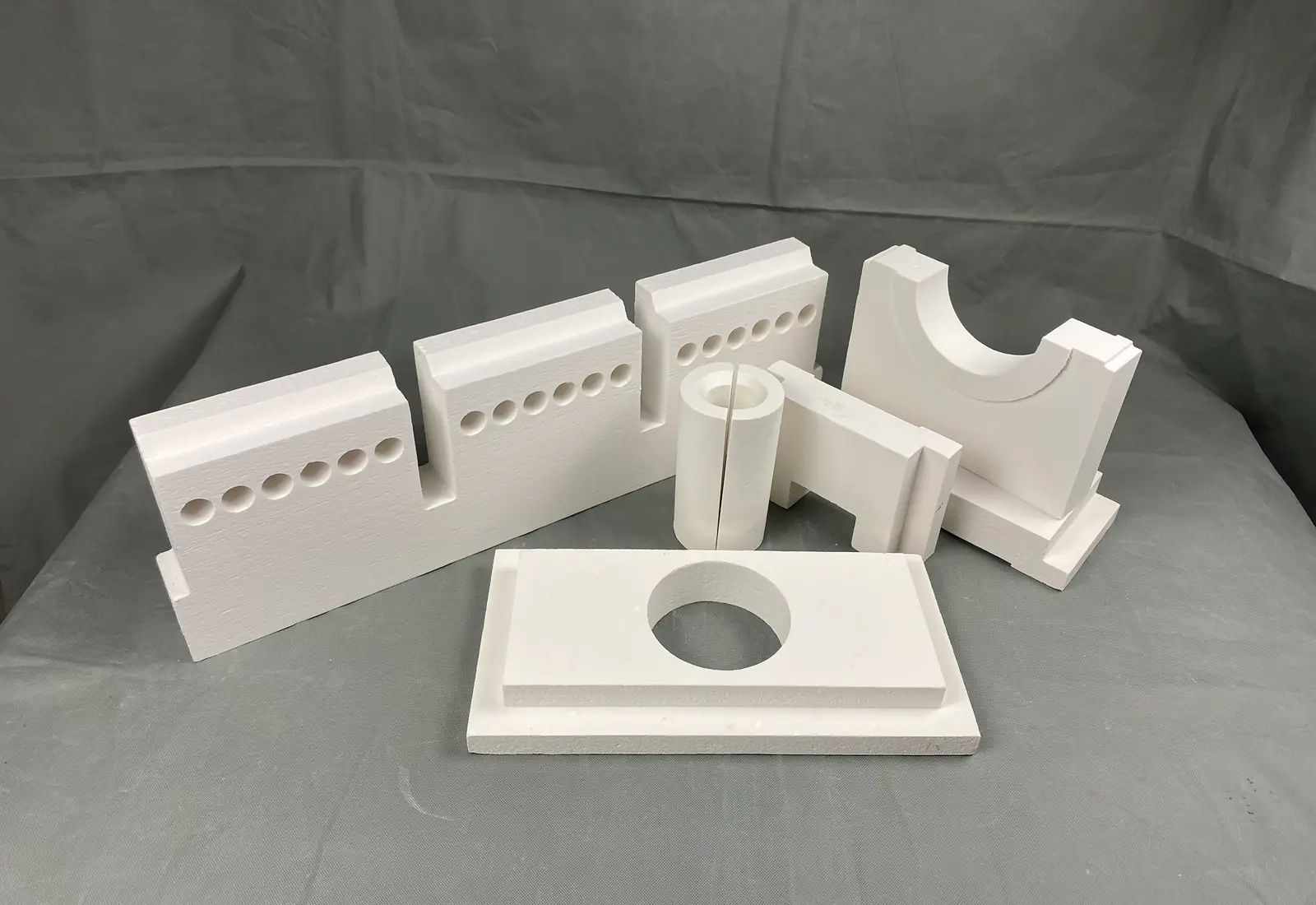
Ceramic fiber samples arranged inside a laboratory furnace before testing

01Material selection guide

Ceramic fiber temperature grade and density

Select ceramic fiber grade, product form, density and thickness from the operating temperature, atmosphere, cycle and installation conditions.

7 grades1260–1900 available
Densityselected by product form
Temperaturenormal and peak conditions

02Overview

Temperature grade is only one part of the product specification. Product form, normal and peak temperature, atmosphere, cycling, available thickness, handling and mechanical loading must also be specified.

03Technical information

Select the product form and operating conditions with the temperature grade.

Do not select ceramic fiber from the highest temperature number alone. Begin with the material form and exact lining position, then consider normal and peak temperature, atmosphere, cycling, available thickness, density, handling and mechanical exposure.

Ceramic fiber board with grade-dependent density
01

What temperature grade means

Available grades are 1260, 1400, 1500, 1600, 1700, 1800 and 1900. The available density, dimensions and property values still depend on whether the product is board, blanket, paper, a module, a formed part or an engineered chamber.

  • Available grades from 1260 to 1900
  • Product-specific availability
  • 1900 grade maximum service up to 1800°C
Ceramic fiber blanket supplied in selected density configurations
02

What density changes

Density is connected to product construction and grade. It can influence handling, compression, machining and the way a part fits the application, so the same density should not be copied automatically across board, blanket, paper and formed components.

  • Normal range depends on product and grade
  • Special density is available for defined requirements
  • Specify density only when the application needs it
Vacuum-formed ceramic fiber parts with different bores, channels and support profiles
03

Why thickness and atmosphere matter

Temperature grade alone cannot account for insulation thickness, atmosphere, cycling, direct heat exposure or mechanical loading. These conditions must be specified for the exact lining position.

  • Normal and peak temperature
  • Atmosphere and cycle frequency
  • Available space and mechanical exposure

04Selection table

Variables that complete a ceramic fiber specification

Use the operating conditions and installation position to narrow the product. Property values in the final quotation apply to the stated product form and grade.

VariableWhat to provideWhy it mattersCommon mistake
Product formBoard, blanket, paper, module, formed shape or chamberDefines construction and available processingChoosing grade before choosing the function
TemperatureNormal, peak and location within the liningSets the thermal selection boundaryUsing only the furnace controller set point
Atmosphere and cyclingGas environment, ramp, hold and cycle frequencyChanges material exposure and selectionAssuming all furnace conditions are equivalent
DensityRequired value or performance reasonRelates to handling, compression and product constructionApplying one density to every grade and form
Thickness and geometryAvailable space and required dimensionsDefines the insulation build and heat pathTreating thickness as a purchasing detail only
Mechanical exposureLoad, abrasion, movement, machining or compressionMay change form, density and surface treatmentSelecting only by temperature

05Product selection steps

Turn a grade number into a product-specific line item.

The quotation should state the product form, operating conditions, grade, density and finished dimensions.

Furnace chamber engineering detail
  1. 01

    Identify the insulation function

    Define the layer or component and choose the likely material form.

  2. 02

    Record operating conditions

    State normal and peak temperature, atmosphere, cycling and direct exposure.

  3. 03

    Set physical variables

    Confirm thickness, dimensions, density, compression, machining and interfaces.

  4. 04

    Complete the technical record

    Attach the product data sheet, quoted specification and drawing revision that match the selected form and grade.

08Technical FAQ

Temperature grade and density questions.

01What ceramic fiber temperature grades are available?+

SYNTHE offers 1260, 1400, 1500, 1600, 1700, 1800 and 1900 grades across applicable product forms.

02What is the maximum temperature for 1900 grade material?+

The maximum service temperature for 1900-grade material is up to 1800°C, subject to product form, atmosphere and operating conditions.

03Does a higher density always mean better insulation?+

No. Density must be considered with product form, grade, thickness, handling, compression and mechanical exposure. The highest density is not automatically the best selection.

04Can a special density be supplied?+

Yes. Special density is available where the product form, geometry and application allow it.

10Specification support

Match material grade and density to the operating conditions.

Provide continuous and peak temperature, atmosphere, mechanical loading, exposed surface and product form so SYNTHE can select grade and density as one insulation system.